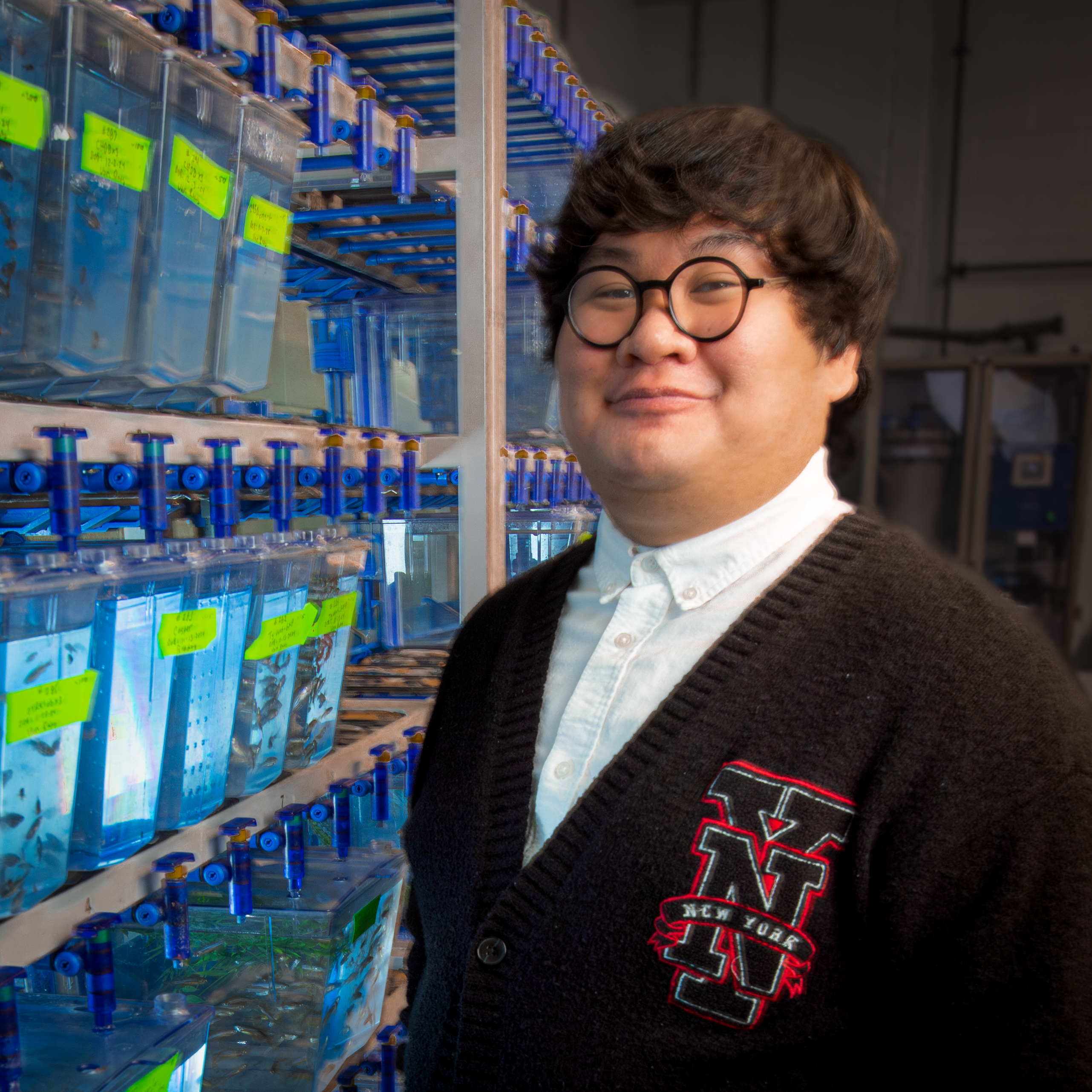
To future graduate students, it is important to keep a clean, legible, and logical lab notebook! Also remember that your brain is your best weapon to succeed in graduate school and it functions best when it is well-rested; only pull all-nighters if necessary. Learn to manage your time and try not to do multiple things at once; multi-tasking in the lab can lead to errors in experiments. Finally, enjoy your time and get all the food and freebies from conferences and other events!
Words of wisdom for someone considering grad school...
My advice would be to not be afraid to try anything. Take any opportunities you have for new experiences because you never know what you will end up liking! If I had not tried a wide variety of courses during my time at the University of Guelph, I would not have discovered my interest in reproductive biology. Also, take any opportunity you can to speak with other graduate students; everyone is extremely friendly and always willing to lend a hand if you need it. Your peers are a great resource and are always willing to offer some advice on school, research, or life.
I couldn't imagine a better fit than the University of Guelph. The opportunity to work within a dynamic, interdisciplinary team of graduate students across campus as an inaugural Arrell Food Fellow was an extremely enriching experience on both academic and professional development fronts that sets U of G apart. Under the leadership of the world renowned food scholar Dr. Evan Fraser, the Arrell Food Institute supported my aspirations to develop an innovative food product for student nutrition programs by connecting me with industry partners off campus in addition to the plethora of researchers and staff on campus to enhance my doctoral research. The Arrell Food Institute, CBaSE, the Catalyst Centre, the Accelerator Program, the Guelph Food Innovation Centre and the close proximity of OMAFRA across the street from the university are world-class resources that enhanced my U of G experience everyday. U of G invests in its students both academically AND professionally, offering a large suite of programs and specialized resource centres that assist students in developing research as well as business skills which accelerate their alumni post-graduation.
Absolutely take the time to reach out to current students, alumni, and faculty members affiliated with the grad programs of consideration. Your grad school experience will very much be influenced by the people you are surrounded by during your education and the culture of the program. Hearing from other's experiences and talking to current students is one of the best ways to find the right fit for you.
I highly recommend University of Guelph graduate studies for the prospective grad student who is looking to build their skills and improve their knowledge. This great learning experience will make students more employable in the labor market. The best thing in grad studies is the working opportunities offered to students while studying which improves their networking and can prepare them for the labor market.
Choose a supervisor who makes you excited about your project. There will be times when your project does not go as planned and reminders of that enthusiasm and why you are doing the work are crucial to continuing through the hurtles.
My student philosophy is that anyone can learn anything. However, to succeed and enjoy your graduate school education you need to create good relationships with your mentors and those you look up to and get involved in student life by joining things that resonate with you whether that be student councils, clubs, intramural teams, etc!
I lived in Ridgetown as this is where my research was conducted. Although Ridgetown does not have much infrastructure in comparison to the City of Guelph, it has large acres of land for research in agriculture. I sometimes enjoyed a tour on the vast land with various research work going on. Personally, I think Ridgetown may be the town with the kindest people I have met, and I know the same is true for the City of Guelph.
“As a U of G student I have taken part in many intramural sports including soccer, softball, football, hockey and volleyball. I have had great experiences, both as an intramural player and captain. The availability of such a wide variety of athletic opportunities for students is a great addition to the university.”